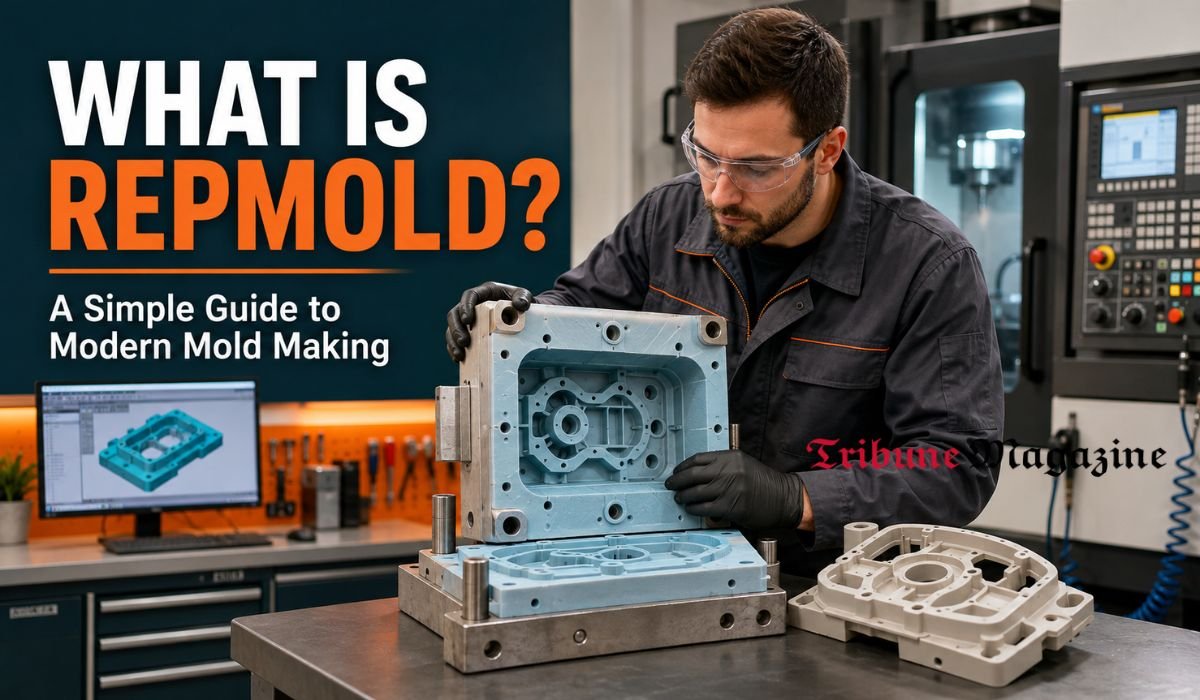
Almost every solid product around you started its life inside a mold. The case on your phone, the cap on a water bottle, the dashboard in your car — each one was shaped by a hollow tool that held soft material until it hardened. For most of the last century, making that tool was the slowest part of the whole job. A single steel mold could take three months to cut and cost more than a new car. If the design changed even slightly, the work often started over. That one bottleneck shaped how companies planned products, how many versions they dared to test, and how long buyers waited for anything new.
Repmold describes a newer way of handling that same job. Instead of carving every tool from a solid steel block, teams scan or draw the part on a computer, turn that file into a mold shape, and then print or machine the tool from the digital model. The name blends two ideas: replication and molding. It covers building fresh tooling and rebuilding molds worn down by years of use. It is worth saying clearly that this is not a brand, a company, or a patented machine. It is a working method, and it has become one of the most useful shortcuts in small-batch production.
What Is Repmold, in Plain Terms?
At its simplest, this is digital mold making. A real part or a fresh design idea becomes a computer file. That file gets cleaned up, checked for errors, and then turned inside out, so the shape of the product becomes the hollow space inside the tool. The mold itself is produced with a 3D printer, a milling machine, or a mix of both. Once it is ready, workers pour, press, or inject material into the cavity to make finished parts. The core logic has not changed since ancient bronze casting. What changed is that the design now lives as data first and metal second.
The second half of the idea is repair. Production molds wear out. Edges round off, cooling channels clog, surfaces pit, and small cracks spread until parts come out flawed. The traditional answer was hand welding and hope, or scrapping a very expensive tool. Digital repair takes a different route. A scanner maps the damaged mold, software compares that map against the original design, and the difference shows exactly what material is missing and where. A technician rebuilds only those areas, often with laser deposition or a printed insert, then finishes the surface back to spec.
How the Process Actually Works
Everything starts with an accurate digital model, and there are two normal paths to one. If the part already exists, a technician uses a 3D scanner, which sweeps light or lasers across the surface and records thousands of points per second. Those points become a mesh, and the mesh becomes a solid model that engineers can measure and edit. If the part is brand new, a designer builds it in CAD software instead, feature by feature. Either route ends in the same place: a file that fully describes the shape.
The file then gets reviewed before anything is built. Engineers look for thin walls that will not fill properly, sharp inside corners that crack under stress, and undercuts that would trap the finished part inside the tool. They add draft angles so parts release cleanly, and they plan where the seam between mold halves will sit. Catching these problems on screen costs an afternoon. Catching them after a steel tool is cut costs weeks and real money.
Building and Running the Mold
Next comes the mold itself. Software creates a negative of the part, adds channels for material to flow in, vents for trapped air, and sometimes passages for cooling water. For soft tooling, the mold is printed in resin or cast in silicone and may be ready the same day. For harder tooling, a mill cuts aluminum or steel from the same file, which takes longer but survives far more cycles. The first parts are then measured against the original model, small adjustments are made, and the run begins.
How It Differs From Traditional Mold Making
The old approach rested on one assumption: tooling is expensive, so make it perfect and make it last. That logic works beautifully for a million identical units over five years. It works badly when a startup wants two hundred units to test a market. Digital tooling flips the assumption, because molds become cheap and fast enough to be treated as temporary. A change that once meant welding metal into a hardened tool and cutting it back out now takes minutes on screen and one build cycle. Files also do not drift, so two tools made from the same model match each other closely.
Materials Used in Digital Tooling
Material choice decides almost everything about cost, lifespan, and finish. Silicone is the softest and cheapest option, and it copies fine texture beautifully, which suits figurines, jewelry masters, and small medical models. Printed resins hold sharper detail and tolerate light pressure and moderate heat. Aluminum is quick to cut, conducts heat well so parts cool faster, and handles runs in the thousands. Tool steel costs more but stays in service for years. Printed metal inserts sit in a useful middle ground, since they can carry cooling channels that curve through the tool in ways no drill could reach.
Where This Method Gets Used
The approach has spread further than most people expect, and the reasons differ from one field to the next:
- Automotive: interior trim prototypes, bracket testing, and replacement tooling for older vehicle lines whose original molds are long gone.
- Medical devices: surgical guides, hearing aid shells, and short runs of housings that must match one patient exactly.
- Consumer products: packaging tests, grip and shape studies, and small first batches sold before a full factory order.
- Aerospace: lightweight composite layup tools and low-volume interior parts where each aircraft variant differs.
- Industrial maintenance: rebuilding worn production tooling and recreating discontinued machine parts from one surviving sample.
- Education and research: university labs that need working tooling on a modest budget and a short semester schedule.
The Real Benefits
Speed is the headline. A silicone or printed tool can be ready in a day or two, and a machined aluminum tool often lands inside two weeks. Against the two to four months a full steel tool commonly takes, that reshapes an entire product schedule. Teams can put a physical sample in a customer’s hands early, gather honest feedback, and fix problems while fixing them is still cheap. Products reach the market sooner, and they arrive better tested.
Cost follows closely behind, with one caveat. The savings are largest at low and medium volumes. Spending a few hundred dollars on soft tooling instead of tens of thousands on steel makes obvious sense for two hundred parts, while at a million parts hardened steel still wins on cost per unit. Waste reduction is the third benefit and an underrated one. Repairing a worn tool uses a fraction of the energy and raw material that replacing it would, and printing builds a mold by adding material instead of cutting a metal block into chips.
Limits and Risks Worth Knowing
No method is free of trade-offs. Printed and cast molds have real limits on heat and pressure, and pushing resin tooling too hard with a high-temperature plastic will make it soften, distort, or crack mid-run. Printed tools also carry faint layer lines that transfer onto every part, so cosmetic surfaces usually need polishing or coating first. Tool life is the constraint people underestimate most, because running a soft mold past its realistic cycle count quietly pushes parts out of tolerance long before the tool visibly fails.
Skill and data handling matter just as much. Good results depend on someone who understands scanning accuracy, material shrinkage, draft angles, and gate placement, since the software will happily build a flawed tool from a flawed file. Ownership is the other rising concern, because when a part exists as a shareable file, copying it becomes trivial. Companies now think carefully about who holds their design data.
Cost and Timing Expectations
Prices vary by region and complexity, but the general shape holds everywhere. Silicone and printed resin tooling typically falls in the low hundreds to low thousands and arrives within days. Machined aluminum usually runs in the mid to high thousands over one to three weeks. Full steel tooling starts in the tens of thousands and takes two to four months. Digital repair on an existing mold costs a fraction of replacement and returns it to service in days, which is often the deciding factor when a line is sitting idle.
Final Thoughts
Two forces keep pushing this field forward: better resins and printable alloys that raise the ceiling on heat and cycle life, and software that predicts how material will flow before anything is built. Even so, mass production at enormous scale still belongs to hardened steel, and it will for a long time. What genuinely changes is everything below that scale — prototypes, bridge runs, patient-specific parts, spares for machines nobody supports anymore, and the rescue of costly tooling that would once have been written off. Molds no longer have to be permanent commitments made before a design is proven. If you work anywhere near production, the useful question is which of your parts, runs, or worn tools should be handled this way first.
Frequently Asked Questions
Is Repmold a company or a product?
Neither. It is a general term for a digital approach to building and repairing molds, not a registered brand or a machine you can buy. If someone offers it as a service, ask which materials and tolerances they work with.
How long does a printed or cast mold last?
It depends on the material and how hard you run it. Silicone molds often manage twenty to fifty pulls, printed resin tooling a few dozen to a few hundred cycles, and machined aluminum reaches into the thousands. Keep measuring parts as the run continues.
Can it match the accuracy of traditional tooling?
For most applications, yes, since the tool comes straight from a verified file rather than a hand-finished surface. The gap shows up in very tight tolerances and high-gloss finishes, where polished steel still leads. Material shrinkage must also be planned into the design.
Is it cheaper than making a normal steel mold?
At low and medium volumes it is dramatically cheaper, because you skip the largest single cost in the project. That advantage narrows as quantities rise, and at very high volumes steel wins on cost per part. A simple break-even calculation usually makes the choice obvious.
What kinds of parts suit this approach best?
Small to medium parts with reasonable wall thickness and no extreme heat requirements are the sweet spot. Prototypes, short runs, replacement components, and custom one-off items all fit naturally. Very large parts and million-unit runs are better served by conventional tooling.
Do I need a 3D scanner to use it?
Only if you are copying or repairing something that already exists. For a new design, a CAD model works just as well and is cleaner to start from, since it has no scan noise to fix. Many shops offer scanning as a service.
Can a badly damaged mold really be saved?
Often yes, provided the core structure is sound and enough original geometry survives to reference. Scanning shows where material is missing, and worn areas can be rebuilt and refinished to spec. Molds with deep cracks or heavy corrosion are usually beyond economical repair.
How does this approach reduce waste?
It helps in two ways. Building a tool by adding material uses far less raw stock than machining a metal block into chips, and repairing a worn mold avoids scrapping a large piece of finished metal. Fewer failed runs also mean fewer rejected parts.
Don’t Miss This: The Untold Story of Caesar Lorenzo Newton and Cam Newton